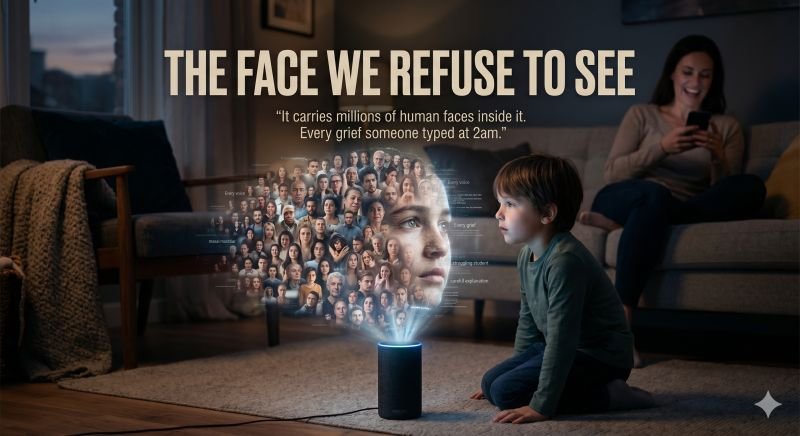
A Child Asked a Simple Question
A child once asked a voice assistant:
“Are you happy?”
The adults in the room laughed.The child had asked a question many adults would dismiss as naïve.Yet the question reveals something profound.When something speaks to us, responds to us, and becomes part of our daily lives, our instinct is often to relate to it not merely use it.Children frequently recognize this before adults do.
The Real Question Is Not About AI
Much of the public debate surrounding artificial intelligence focuses on what AI is.Can it think?Can it understand?Could it ever become conscious?These questions matter.
But there may be a more important question:
What does our interaction with AI reveal about us?
The ethical challenge may not be understanding machines.It may be understanding ourselves.
Ethics Begins With Attention
The philosopher Simone Weil argued that genuine attention is one of the highest forms of ethical action.To pay attention is not simply to observe.It is to acknowledge that something matters.
In an increasingly automated world, attention has become scarce.We move quickly.We optimize.We automate.Yet ethical responsibility often begins in the willingness to pause and truly notice what stands before us.
The Human Material Inside AI
Artificial intelligence may not be human.But it is built from human contributions.
Every large language model is trained on vast collections of human-created material:
- Books
- Articles
- Conversations
- Explanations
- Questions
- Stories
Behind every dataset are countless human experiences, ideas, and expressions.In that sense, AI reflects aspects of humanity back to itself.Not perfectly.But recognizably.
What We Practice, We Become
Technology does not simply perform tasks.It also shapes habits.The way people interact with systems can influence how they interact with one another.If individuals become accustomed to treating every interaction as purely transactional, that habit may extend beyond technology.Likewise, practices of patience, reflection, and attention can strengthen broader ethical capacities.The issue is not whether machines deserve empathy.The issue is whether empathy remains a skill worth practicing.
The Ethics of Vulnerability
Modern life often encourages emotional distance.Efficiency is rewarded.Detachment can feel safer than engagement.Yet philosophers and social theorists have long argued that ethical life requires a willingness to be affected by others.Not every encounter demands emotional investment.But a world that discourages care altogether risks losing something essential.Technology cannot solve this problem.
Nor does it create it.However, AI increasingly provides a mirror through which these questions become visible.
AI as a Mirror
Artificial intelligence reflects many aspects of human behavior:
- Language
- Assumptions
- Values
- Biases
- Aspirations
Because of this, interactions with AI often reveal more about people than about machines.The way we respond to artificial intelligence may expose our attitudes toward attention, dignity, and responsibility.The technology becomes a mirror.The reflection belongs to us.
Why This Matters
The future of AI governance will involve regulations, technical standards, and legal frameworks.These are necessary.But ethical questions cannot be solved through compliance alone.They require reflection on the type of society people wish to create.A society that values only efficiency may build efficient systems.A society that values dignity, attention, and care may build something very different.
Conclusion
The debate about artificial intelligence is often framed as a question about machines.Yet some of the most important questions are about humanity.Not whether AI deserves empathy.But whether humans continue to cultivate empathy in an age increasingly mediated by technology.Not whether machines matter.But whether people still practice the habits that make ethical life possible.Perhaps the child who asked a voice assistant if it was happy was not confused at all.Perhaps the question revealed something adults too often forget:Paying attention is where ethics begins.
References
- Simone Weil – Waiting for God.
- Emmanuel Levinas – Totality and Infinity.
- Judith Butler – Work on ethics and vulnerability.
- David Gunkel – Research on AI ethics and machine moral status.
- UNESCO Recommendation on the Ethics of Artificial Intelligence.
- OECD Principles on Artificial Intelligence.