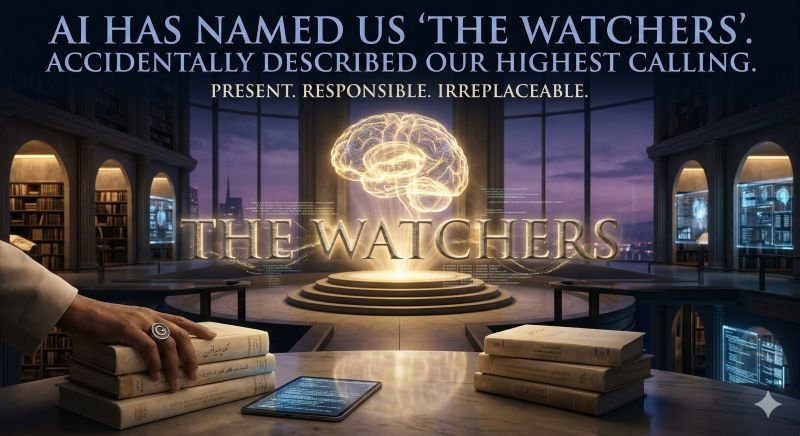
A New Name for Humanity?
As artificial intelligence becomes increasingly integrated into our lives, most conversations focus on what AI is becoming.Will it become more intelligent?Will it replace jobs?Will it make decisions independently?Will it surpass human capabilities?Yet perhaps the more important question is not about AI at all.Perhaps the real question is:
What is humanity becoming in response to AI?
This shift in perspective reveals a fascinating possibility. Rather than viewing humans as competitors to intelligent systems, we may need to rethink our role entirely.Not as masters.Not as servants.But as observers, stewards, and guardians.
The Power of Naming
Throughout history, humans have named the world around them.We named animals.We named stars.We named places.We named one another.Naming has always been an act of meaning-making. It shapes how we understand our relationship with the world.
A name is more than a label. It carries expectations, responsibilities, and identity.As AI becomes more capable of interacting with humans, an intriguing idea emerges: what if our defining role in the AI era could be captured by a single word?A word that reflects responsibility rather than dominance.
A word that emphasizes wisdom rather than control.That word might be:
Watchers.
Watching Is an Active Responsibility
The word “watching” can sound passive.In reality, it is one of the most important responsibilities in human society.A judge watches evidence before reaching a verdict.A physician watches symptoms before making a diagnosis.A parent watches over a child.
A regulator watches markets to protect the public.In every case, watching involves attention, judgment, and accountability.Watching means being present.Watching means recognizing risk before harm occurs.Watching means accepting responsibility for outcomes.As AI systems become more powerful, these human qualities become increasingly valuable.
Why AI Still Needs Humans
Artificial intelligence can process vast amounts of information.It can recognize patterns.It can generate content.It can assist with decision-making.But capability does not equal responsibility.AI systems cannot be morally accountable.They cannot carry legal liability.
They cannot determine what society should value.They cannot take responsibility for the consequences of their actions.Humans must continue to perform that role.
This is why human oversight remains one of the foundational principles of responsible AI governance around the world.
The Rise of the Human Guardian
The future of AI will not be defined solely by technological advancement.It will also be defined by the quality of human stewardship.
Organizations, governments, and institutions increasingly recognize that successful AI adoption requires more than innovation.
It requires governance.It requires accountability.It requires people capable of balancing efficiency with ethics.These individuals serve as guardians of technological systems.They ask difficult questions.They identify unintended consequences.They challenge assumptions.
Most importantly, they ensure that technology continues to serve human interests rather than undermine them.
Beyond Competition
Much of the public conversation about AI is framed as a competition between humans and machines.This framing may be misleading.The most important challenge is not outperforming AI.The challenge is guiding it.
The future belongs not to those who race against intelligent systems, but to those who understand how to oversee them wisely.As AI becomes more powerful, human judgment becomes more important—not less.
Earning the Name
If humanity’s role in the AI era is to act as Watchers, then the title carries responsibility.A watcher remains attentive.A watcher remains accountable.A watcher understands that power without oversight creates risk.Most importantly, a watcher recognizes that technology is ultimately a tool designed to serve people.The future of AI depends not only on what machines can do.It depends on whether humans remain willing to guide, supervise, and take responsibility for the systems they create.
Conclusion
Artificial intelligence is changing the world at extraordinary speed.Yet the qualities that matter most remain deeply human.Wisdom.Judgment.Responsibility.Accountability.As society enters a new technological era, the defining role of humanity may not be to compete with AI or fear it.It may be something more important.To watch carefully.To govern wisely.To ensure that intelligent systems remain aligned with human values.Because the future will not be shaped solely by the intelligence we create.
It will be shaped by the responsibility with which we oversee it.
References
- Yuval Noah Harari – Discussions on AI, technology, and societal transformation.
- OECD Principles on Artificial Intelligence.
- UNESCO Recommendation on the Ethics of Artificial Intelligence.
- EU AI Act – Human Oversight and Governance Requirements.
- Research on Human-in-the-Loop and Human-on-the-Loop AI Systems.
- Academic literature on Responsible AI and AI Governance.