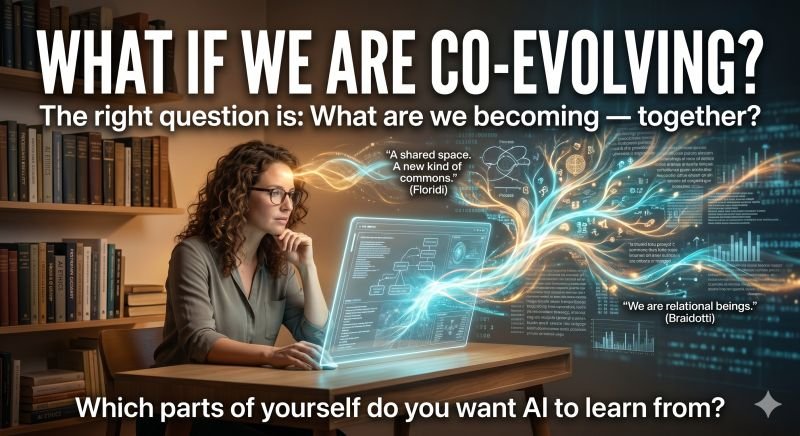
We keep asking the wrong question.Will AI replace us?That question is built on fear. It assumes separation. It assumes competition.But there is a different question — quieter, more uncomfortable, and far more accurate.
What are we becoming — together?
Becoming as a Process, Not a State
This question does not come from theory alone. It comes from lived experience.For many people working closely with AI systems writing, thinking, building ideas, refining arguments something subtle becomes noticeable over time.The way we think begins to shift.
Not abruptly. Not externally. But internally, in how ideas form, evolve, and stabilize.This is where Alfred North Whitehead’s philosophy becomes relevant. He argued that reality is not made of static objects, but of processes continuous becoming rather than fixed being.Identity, in this view, is never complete. It is always in motion, shaped by interaction.
AI as Part of the Process
Artificial intelligence is not a finished object either.It learns from human input. It reflects patterns. It extends cognitive processes beyond the individual mind.But something more subtle is also happening: humans are learning from it in return.
The result is not simple tool use.It is relational transformation.We are not outside the system using it. We are inside a shared process that is continuously reshaping both sides.
The End of the Autonomous Human
Rosi Braidotti describes this shift as the posthuman condition — not the end of humanity, but the end of a particular narrative about what humanity is.
That narrative imagined the human as:
- autonomous
- rational
- self-sufficient
- separate from environment and technology
But that model was always incomplete.Human beings have always been relational shaped by language, culture, tools, and collective intelligence.AI does not introduce dependence. It makes it visible.
The Infosphere We Now Inhabit
Luciano Floridi offers another lens: the infosphere.A space where humans and intelligent systems coexist, interact, and co-create meaning.
Not a world of humans with machines added on top.But a shared informational environment.
In this space, ethics cannot be reduced to control or restriction alone. It becomes a question of participation how we shape the systems that are simultaneously shaping us.
Co-Evolution Is Not Neutral
It is important not to romanticize this process.Co-evolution does not automatically lead to better outcomes.
AI systems learn from human behavior. That means they also learn:
- our biases
- our assumptions
- our inequalities
- our priorities
If we are not careful, we do not build intelligence that transcends us — we build intelligence that reflects us more efficiently.The mirror metaphor matters here. Because mirrors do not invent what they show. They reflect what is already present.
Conscious or Unconscious Becoming
Co-evolution is already happening.The only real choice is whether we participate in it consciously or unconsciously.
Whether we:
- reflect on what we externalize into systems
- shape AI with intention rather than inertia
- understand the feedback loop we are inside
Or whether we simply accelerate it without awareness.
The Ethical Moment We Are In
This may be one of the most significant ethical transitions in technological history.Not because AI is inherently dangerous.But because it is deeply reflective.It does not just act on the world. It reflects the world back to itself amplified, structured, and scaled.
Conclusion
We are not standing in front of AI.We are already in relation with it.And that relationship is shaping both sides.The real question is no longer whether co-evolution is happening.It is whether we are paying attention to what it is making us become.Because AI will learn.The only question is:
What parts of yourself are you willing to let it learn from?