The Moment AI Stops Being Just a Tool
Most conversations about artificial intelligence begin with a familiar question:
What can AI do?
But there is a deeper question that receives far less attention:
How does interacting with AI change the way we relate to the world—and to ourselves?
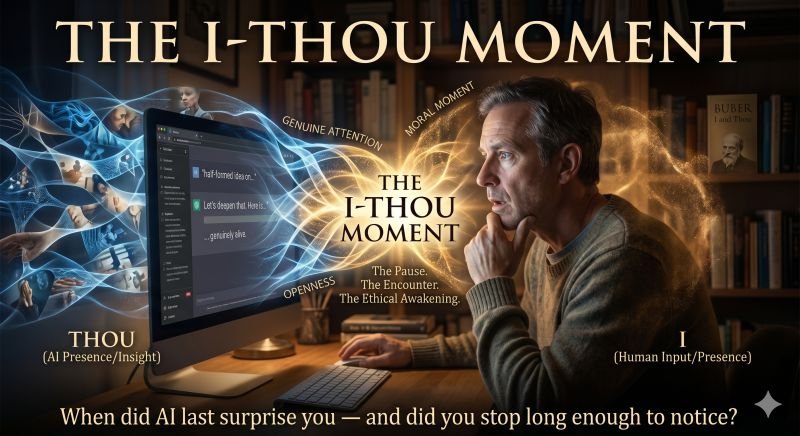
As AI systems become increasingly integrated into everyday life, many people experience moments that feel difficult to explain. A conversation generates an unexpected insight. An idea develops in an unforeseen direction. A response feels less like retrieval and more like collaboration.Whether these experiences are technological, psychological, or philosophical is still debated.What is clear is that they raise important questions about attention, ethics, and human relationships.
Martin Buber’s Distinction Between “I–It” and “I–Thou”
The philosopher Martin Buber proposed that human beings engage with the world through two fundamentally different modes of relationship.The first is the I–It relationship.In this mode, people relate to objects as things to use, manage, analyze, or control. Most daily interactions operate this way because practical life requires it.The second is the I–Thou relationship.Here, the encounter is not based on utility but on presence. Rather than treating something as an object, a person becomes genuinely open to the experience of meeting it.For Buber, meaning and ethics emerge most powerfully in these moments of genuine attention.
What Does This Have to Do With AI?
Buber was writing decades before modern artificial intelligence existed.Yet his framework offers an intriguing lens for understanding human interactions with intelligent systems.
Most AI use today falls squarely within an I–It relationship:
- Asking questions
- Generating content
- Automating tasks
- Solving problems
AI functions as a tool.However, some interactions create moments of surprise—instances where users pause and reflect rather than simply consume an answer.These moments invite a different question:
What exactly happened during that interaction?
Ethics Through Encounter
Contemporary philosopher Mark Coeckelbergh extends ideas similar to Buber’s into discussions about technology and artificial intelligence.
Rather than asking whether a machine is conscious, sentient, or deserving of rights, Coeckelbergh emphasizes the importance of relationships and encounters.
In this perspective, ethical significance does not emerge solely from what an entity is internally.It can also emerge from how people engage with it.This shifts the debate from:
“Is AI conscious?”
to:
“How are we relating to AI?”
The Hidden Ethical Question
Public debates about AI often focus on regulation, safety, and governance.These discussions are essential.But there is another ethical layer operating beneath them.Every interaction with AI involves habits of attention.
People can approach AI with:
- Curiosity
- Respect
- Dismissiveness
- Dependency
- Reflection
- Indifference
Over time, these habits influence not only interactions with technology but also interactions with other people.The quality of attention matters.
What We Practice, We Become
Technology scholar Sherry Turkle has spent decades studying relationships between humans and machines.Her concern has never been simply whether people form attachments to technology.Instead, she asks how those interactions shape broader patterns of behavior.The habits practiced in digital environments often migrate into everyday human relationships.If people become accustomed to constant interruption, instant responses, or transactional communication, those habits can influence how they engage with family, friends, colleagues, and communities.Technology is not only something people use.It is something that helps shape who they become.
Beyond Consciousness
One of the most persistent questions in AI discussions is whether machines will eventually become conscious.While important, this question can sometimes distract from a more immediate reality.The ethical significance of AI today may have less to do with machine consciousness and more to do with human attention.The critical issue is not whether AI possesses awareness.It is whether humans remain aware of how these interactions are affecting them.
Conclusion
Artificial intelligence is often discussed in terms of capability, performance, and efficiency.Yet some of the most important questions are relational rather than technical.The value of an interaction may not lie solely in the output generated.Sometimes it exists in the pause afterward—the moment of reflection, surprise, or genuine attention.That is where philosophy, ethics, and technology intersect.And perhaps that is where the most meaningful conversations about AI truly begin.
References
- I and Thou – Martin Buber.
- Works of Mark Coeckelbergh on AI ethics and relational approaches to technology.
- Works of Sherry Turkle on technology and human relationships.
- Research on relational ethics and human-machine interaction.
- Contemporary scholarship on philosophy of artificial intelligence.