- Artificial Intelligence Has Become a Professional Competency
- Generic AI Knowledge Is No Longer Enough
- Why Lawyers Need Specialized AI Training
- AI Literacy Is Also a Business Strategy
- Responsible AI Starts With Education
- Building AI Skills That Matter
- AI Literacy Will Define Competitive Advantage
- Final Thoughts
- References
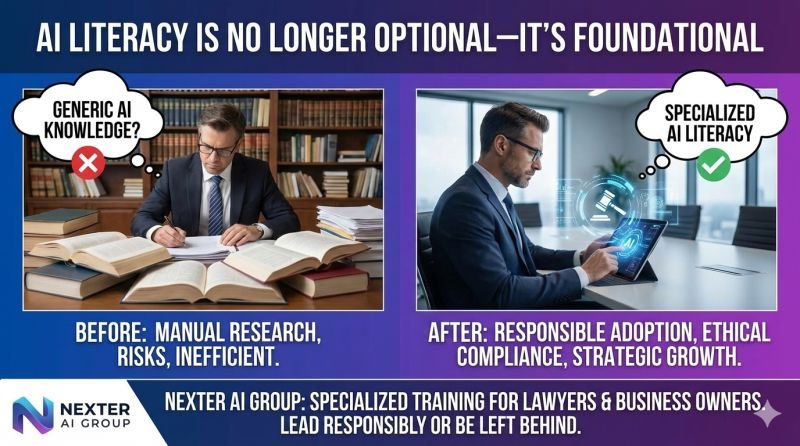
Artificial Intelligence Has Become a Professional Competency
There was a time when understanding artificial intelligence was considered a competitive advantage.That time has passed.Today, AI literacy is rapidly becoming a core professional competency alongside legal knowledge, financial literacy, leadership, and digital skills.This shift became even more evident when OpenAI announced free access to ChatGPT for K–12 educators through June 2027. While the initiative focuses on education, its broader message is unmistakable:
AI education should be accessible, practical, and tailored to the people using it.
The same principle applies across every profession.Learning how to write prompts is not enough.Professionals must understand how AI fits into the ethical, operational, and regulatory realities of their own industries.
Generic AI Knowledge Is No Longer Enough
Many professionals have experimented with ChatGPT or other generative AI tools.They have written emails.Summarized reports.Generated presentations.Perhaps even drafted contracts.But using AI occasionally is very different from understanding how to integrate it responsibly into professional practice.Lawyers, business owners, accountants, consultants, and executives all operate within different legal, ethical, and commercial frameworks.
An AI course designed for marketers cannot adequately prepare a solicitor dealing with privileged client information.Likewise, a business owner adopting AI for customer service faces different governance responsibilities than a healthcare provider using AI in clinical settings.
AI education must become profession-specific.
Why Lawyers Need Specialized AI Training
The legal profession faces unique responsibilities that extend well beyond productivity.Lawyers must protect confidentiality.Maintain professional independence.Exercise legal judgment.Comply with ethical obligations.Understand emerging regulation such as the EU AI Act and national AI guidance.
This means legal professionals need education that answers questions such as:
- When can AI safely assist legal work?
- Where must human review remain mandatory?
- How should confidential client data be protected?
- What disclosures may be required?
- How can firms build AI governance frameworks?
These questions cannot be answered through generic AI tutorials.They require legal context.
AI Literacy Is Also a Business Strategy
Business leaders face a different challenge.
The question is no longer:“Should we use AI?”
Instead, it has become:“How do we use AI responsibly while creating measurable business value?”
Successful organisations are investing in AI education because they recognise that technology alone does not create competitive advantage.People do.
Employees who understand AI can:
- Identify automation opportunities.
- Reduce repetitive work.
- Improve customer experience.
- Make better strategic decisions.
- Recognise governance and compliance risks before they become costly problems.
AI literacy therefore becomes an organisational capability—not simply an individual skill.
Responsible AI Starts With Education
One of the greatest risks organisations face is adopting AI without understanding its limitations.Generative AI can produce inaccurate information.It can introduce bias.It may expose confidential data if used carelessly.It cannot replace professional accountability.Responsible AI begins long before software is deployed.It begins with education.
Professionals should understand:
- AI capabilities
- AI limitations
- Data privacy requirements
- Human oversight principles
- Governance frameworks
- Ethical decision-making
- Regulatory compliance
Without this foundation, organisations risk implementing technology faster than they develop the judgment required to use it safely.
Building AI Skills That Matter
Effective AI education should focus on practical application rather than technical complexity.Professionals do not necessarily need to build AI models.They need to understand how to use existing AI systems effectively and responsibly.
High-value AI education typically includes:
- AI fundamentals for business
- Prompt engineering for professional workflows
- AI governance principles
- Responsible AI implementation
- Legal and regulatory obligations
- Data protection and privacy
- Risk management
- Human-in-the-loop decision making
- AI strategy and organisational adoption
The objective is not to replace expertise.It is to amplify it.
AI Literacy Will Define Competitive Advantage
The organisations leading AI adoption over the next decade will not necessarily have access to better technology.Most businesses will use similar AI platforms.Competitive advantage will come from how effectively people use those tools.
Professionals who understand AI will make faster decisions, design better workflows, serve clients more effectively, and adapt more quickly to regulatory change.Those who do not may increasingly find themselves reacting to change rather than shaping it.
AI literacy is therefore becoming as fundamental as digital literacy became twenty years ago.
Final Thoughts
Artificial intelligence is transforming every profession.But technology alone is never enough.The real advantage belongs to professionals who combine technical capability with sound judgment, ethical responsibility, and continuous learning.Whether you are a lawyer, business owner, executive, or consultant, AI literacy is no longer a future skill.
It is a present-day professional requirement.The organisations investing in education today are preparing not only to use AI—but to lead with it responsibly.
References
- OpenAI. ChatGPT for Education Announcement (2026).
- World Economic Forum. The Future of Jobs Report 2025.
- Microsoft. Work Trend Index 2025.
- McKinsey & Company. The State of AI 2025.
- Deloitte. State of Generative AI in the Enterprise 2025.
- OECD. OECD AI Principles.
- European Union. EU AI Act.
- American Bar Association. Formal Opinion 512: Generative Artificial Intelligence Tools (2024).