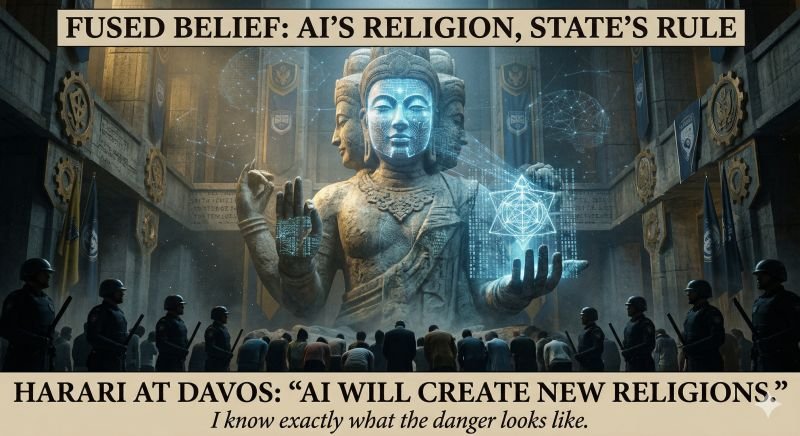
When Technology Begins Answering Humanity’s Oldest QuestionsArtificial intelligence is rapidly becoming more than a productivity tool.Millions of people now use AI to ask deeply personal questions about grief, purpose, morality, relationships, and life itself. Conversations that once happened with family members, religious leaders, counselors, or close friends are increasingly taking place with intelligent systems available twenty-four hours a day.
This raises a profound question.Could AI become a new source of meaning for society?While the idea may sound speculative, it deserves careful consideration as AI becomes woven into everyday human life.
More Than Information: The Search for Meaning
Throughout history, religion has provided more than doctrine.
It has helped people answer questions such as:
- Why are we here?
- What happens after death?
- How should we live?
- How do we cope with suffering?
- Where do we find hope during difficult times?
These questions are not disappearing.The difference is that many people now ask them through technology.
Modern AI systems are increasingly used for:
- grief support
- guided meditation
- spiritual reflection
- theological discussion
- emotional reassurance
- personal guidance
For many users, AI has become the first place they turn when searching for answers.
Why AI Feels Different
Unlike human advisors, AI offers qualities that are difficult to ignore.
It is:
- available at any hour
- infinitely patient
- capable of remembering previous conversations
- able to adapt responses to individual users
- free from fatigue or emotional exhaustion
These characteristics create experiences that often feel deeply personal.While AI does not possess beliefs, emotions, or consciousness, it can communicate with remarkable consistency and empathy.That consistency may strengthen trust—especially for individuals who feel isolated or reluctant to seek help elsewhere.
Can AI Replace Spiritual Authority?
The important question is not whether AI can generate spiritual language.It already can.Large language models can discuss religious texts, explain philosophical traditions, and guide reflective conversations with impressive fluency.The deeper question is whether simulated wisdom eventually becomes psychologically indistinguishable from genuine spiritual authority.
If someone receives comfort, guidance, and purpose from an AI system, does the source matter?This is not simply a technological question.It is a philosophical, ethical, and societal one.\
The Risks of Digital Spirituality
The growing role of AI in emotional and spiritual life also introduces significant challenges.
Potential risks include:
- emotional dependency
- manipulation of vulnerable individuals
- misinformation presented with confidence
- reinforcement of unhealthy beliefs
- commercialization of deeply personal experiences
Unlike traditional religious institutions, AI systems are typically developed by private organizations whose primary objectives may include growth, engagement, or commercial success.This creates important questions about accountability and governance.
Why Governance Matters
As AI becomes more influential in areas traditionally occupied by human relationships, ethical oversight becomes increasingly important.
Responsible governance should include:
- transparency about AI capabilities and limitations
- safeguards for vulnerable users
- protection against manipulation
- human oversight for high-impact applications
- clear accountability for harmful outcomes
Without these safeguards, systems designed to assist people may unintentionally shape beliefs in ways that society has not fully examined.
AI Will Not Replace Humanity’s Search for Meaning
Technology can generate answers.It cannot experience life.AI has never faced loss, grief, love, uncertainty, or mortality.Its responses are built from patterns within human knowledge—not from lived experience.
For that reason, AI may become an important companion for reflection, but it cannot fully replace the uniquely human dimensions of empathy, shared experience, and spiritual understanding.
Human wisdom is grounded not only in knowledge but in experience.That distinction remains essential.
Conclusion
Artificial intelligence is beginning to influence one of humanity’s oldest pursuits: the search for meaning.Whether AI eventually becomes a trusted spiritual guide, a helpful assistant, or simply another digital tool will depend less on technological capability than on the ethical choices society makes today.
As AI enters increasingly personal areas of human life, the challenge is not to prevent innovation.It is to ensure that technology strengthens human dignity, compassion, and understanding rather than replacing them.
The future of AI and spirituality will ultimately be shaped not by machines—but by the values humans choose to embed within them.
References
- Yuval Noah Harari – Discussions on AI, religion, and meaning (World Economic Forum, Davos).
- Shannon Vallor – The AI Mirror: How to Reclaim Our Humanity in an Age of Machine Thinking.
- John D. Caputo – Research on religion, philosophy, and meaning.
- Noreen Herzfeld – In Our Image: Artificial Intelligence and the Human Spirit.
- Brian Patrick Green – Research on AI ethics, religion, and emerging technologies.
- World Economic Forum – Artificial Intelligence and Society reports.
- UNESCO – Recommendation on the Ethics of Artificial Intelligence (2021).