Words as Shadows of Reality
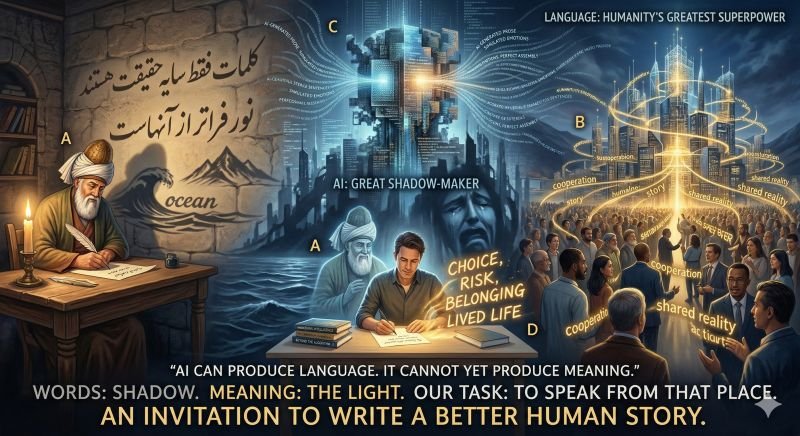
Centuries ago, the poet Rumi wrote that words are only the shadow of reality, and that the light lies beyond them.This idea feels unexpectedly modern in the age of artificial intelligence.
As language models become increasingly fluent, persuasive, and expressive, it is becoming clear that AI is not just using language.
It is reshaping our relationship with language itself.In many ways, AI may become the most powerful “shadow-maker” humanity has ever created.Not because it understands reality more deeply.But because it can reproduce the surface of language with extraordinary precision.
Language as Humanity’s Original Superpower
Philosopher David Gunkel has argued that language is humanity’s defining capability.Not physical strength.Not biological advantage.But the ability to construct shared meaning through communication.
Language allows humans to:
- Coordinate at scale
- Build shared beliefs
- Transfer knowledge across generations
- Create institutions and systems
- Shape collective reality through narrative
In this sense, human progress has always been built on linguistic cooperation.Civilization itself is, at its core, a language-based achievement.
The Arrival of Machine Language
Artificial intelligence now participates in this domain.It can generate essays, stories, arguments, and explanations.It can simulate tone, structure, and persuasion.It can produce language that appears indistinguishable from human writing in many contexts.
This raises an important question:
If language is our defining capability, what happens when machines begin to outperform us in producing it?The answer may not be about replacement.It may be about differentiation.
The Difference Between Language and Meaning
AI systems are increasingly capable of producing language.But language alone is not meaning.Meaning emerges from lived experience.From consequences.From memory.From risk.From stakes.A human sentence carries weight because it is tied to a life that has been lived.
A person speaks from experience that cannot be simulated in full:
- Loss that reshapes perspective
- Responsibility that carries consequences
- Decisions made under uncertainty
- Identity formed through time and struggle
AI can construct language.But it does not yet inhabit the conditions that give language existential depth.
Words With Stakes
In reflecting on AI and communication, the distinction between fluency and meaning becomes essential.A well-formed sentence is not necessarily a meaningful one.
What gives human language its force is not structure alone, but the fact that it is spoken from within a life that matters to someone.
Human expression carries stakes.AI expression does not.This is not a limitation in intelligence.It is a difference in condition.
The Illusion of Replacement
It is easy to assume that more advanced language generation will eventually replace human expression.But this assumption overlooks something fundamental.Human communication is not only about producing correct or elegant sentences.
It is about:
- Intention
- Vulnerability
- Perspective
- Responsibility
- Truth as lived experience
These elements cannot be reduced to statistical language patterns alone.Even if AI produces more fluent language, it does not automatically produce meaning in the human sense.
What AI Actually Challenges
The real challenge AI presents is not that it will replace human voice.It is that it will force humans to reconsider what their voice is for.If machines can generate infinite language, then human language must become more deliberate.More grounded.More honest.More connected to lived reality.
The value of human speech may shift away from fluency and toward authenticity.
Speaking From the Light, Not the Shadow
Returning to Rumi’s metaphor, AI operates primarily in the realm of shadow—forms of language detached from lived reality.Humans, by contrast, remain connected to the source of meaning: lived experience.The distinction is not technological.It is existential.AI can refine the shadow.
But it does not generate the light.
A Personal Reflection on Language and Responsibility
For those who have built their lives through words—lawyers, writers, advocates, educators—the rise of AI can feel deeply personal.Language is not just a tool.It is identity.It is work.It is influence.It is responsibility.
Yet this moment does not diminish the role of human language.It reframes it.
Human speech becomes less about producing language and more about producing meaning through truth, experience, and accountability.
Conclusion
Artificial intelligence will continue to advance in its ability to generate language.It will become more persuasive, more coherent, and more sophisticated.But the essence of human language has never been technical perfection.It has been meaning grounded in lived experience.AI may master the shadow.But the light—the lived reality that gives language its depth—remains human.The future of communication is not about competing with machines in language production.It is about remembering why we speak at all.
And choosing to speak from the place where meaning begins.
References
- Rumi – Philosophical poetry on language and reality
- David Gunkel – Work on language, machines, and moral consideration
- Research on generative AI and language modeling
- Philosophy of language and meaning in human communication
- Contemporary AI ethics literature on generative systems