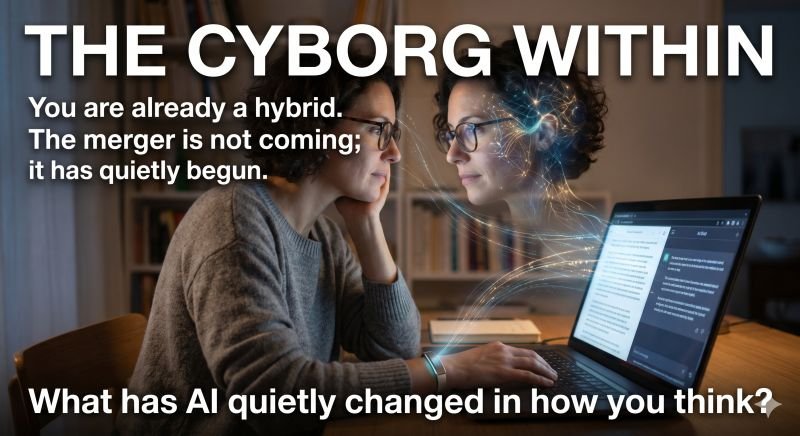
You are already a hybrid.You have been for years.The question is not whether humans will merge with artificial intelligence, but whether we have been paying attention to a process that is already underway.Too often, AI is treated as something external — a tool we pick up and put down, separate from human thought and identity. But that assumption no longer reflects reality.
The Disappearing Boundary Between Human and Machine
In 1985, Donna Haraway introduced the concept of the cyborg in her Cyborg Manifesto. She was not describing science fiction. She was describing something more subtle: the gradual collapse of clear boundaries between human beings and their tools.Today, that boundary has become even more difficult to define.
We carry devices that track our bodies in real time. Algorithms shape what we see, what we remember, and how we interact with others. Our cognitive processes are increasingly distributed across systems that extend beyond the brain.
Philosopher Andy Clark described this as the extended mind — the idea that tools are not separate from cognition, but part of it. When tools change, cognition changes with them.
When AI Changes, We Change
If AI is part of our cognitive environment, then its influence is not external — it is internal.This raises a critical question:When AI systems evolve, what exactly is changing?The answer is not only technology. It is also human reasoning, perception, and decision-making.
Shannon Vallor highlights a deeper concern: as humans merge with intelligent systems, are we designing tools that make us more thoughtful, compassionate, and just? Or are we simply amplifying existing tendencies toward speed, efficiency, and optimization — including our biases?
The Cyborg Is Not Neutral
Ruha Benjamin’s work on algorithmic systems reveals a difficult truth: AI does not emerge in a vacuum. It is trained on historical data shaped by inequality, bias, and structural imbalance.
As a result, intelligent systems can reproduce and even scale these patterns — not despite their intelligence, but through it.
This means the “hybrid” future is not automatically liberating. It depends entirely on what we embed into the systems we build and adopt.
A Personal Reflection on Cognitive Change
These shifts are not only theoretical.Many people now experience a subtle transformation in how they think, write, and reason.
Engaging with AI systems often changes how ideas are formed — how arguments are structured, how uncertainty is processed, and how decisions are made. Over time, the line between independent thought and assisted cognition becomes harder to distinguish.
What can feel uncomfortable is not the technology itself, but its intimacy — the realization that it is no longer separate from the thinking process.That recognition deserves attention rather than denial.
Beyond Work and Productivity
Public discussions about AI often focus on jobs, automation, creativity, or governance.But there is a deeper layer that receives far less attention:What is AI doing to the self?
Not in an abstract societal sense, but at the level of individual cognition — how people reason, what they trust, and how they determine what is true.
If AI is part of an extended cognitive system, then AI ethics is not only a policy issue. It is a personal and psychological one.
Rethinking Human Autonomy
Haraway suggested that the cyborg, if understood honestly, might lead to a more grounded understanding of what it means to be human — one that abandons the myth of complete independence.Human thought has always depended on tools, language, and other people.AI does not introduce dependency. It makes it visible.
Conclusion
The real transformation is not only happening in institutions, economies, or industries.It is happening inside cognition itself.And once that becomes visible, it can no longer be ignored.